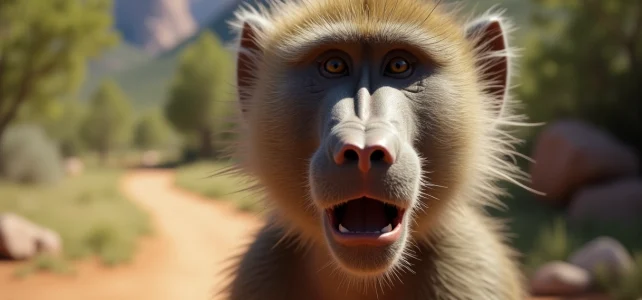
Baboons fascinate not only with their complex social behavior but also with their unique anatomy. Equipped with intriguing physical characteristics, these primates reveal surprising adaptations to their environment.
For example, their elongated snout conceals impressive canines, used both for feeding and for defense. Their colorful bottoms, much more than a mere visual curiosity, play a fundamental role in communication and reproduction. Every detail of their morphology tells a story of survival and social interactions, offering a captivating glimpse into the wonders of evolution.
Further reading : Spotlight on the personal journeys of iconic figures in French journalism
The Physical Attributes of Baboons: A Fascinating Diversity
The anatomy of baboons reveals an astonishing diversity of physical attributes, each serving specific functions in their daily lives. Baboons, or cynocephali, possess morphological characteristics that distinctly set them apart from other primates.
The elongated snout of baboons, for instance, is a major evolutionary adaptation. This trait allows them not only to efficiently forage the ground for food but also to defend themselves against predators with their formidable canines. The canines of male baboons are particularly developed and play a significant role in territorial confrontations.
Read also : Paranormal Investigations: Spotlight on Key Personalities in the Field
The colorful bottoms of these primates, often a subject of curiosity, have a much more complex function than just a visual signal. During mating season, females display swollen and colorful areas of skin that signal their fertility to males. This anatomical feature, often referred to as ‘baboon butt’, is essential in their courtship rituals.
Baboons, through their physical attributes, strikingly illustrate the idea that anatomy is inseparable from ecology and social behavior. Agatharchides of Cnidus, a Greek historian, already described cynocephali as half-human, half-animal creatures, thus highlighting their unique place in the collective imagination of the time.
In ancient Greece, the monkey was seen as a mirror of man, a theological creature. Religious anthropologists and historians of the imagination continue to be interested in these representations, revealing Greek ontological and religious conceptions through the study of baboons. The figure of the monkey in the first millennium BC has particular contours, as evidenced by Aesop’s work and Régis Ladous’ analyses on Adam and the priest. 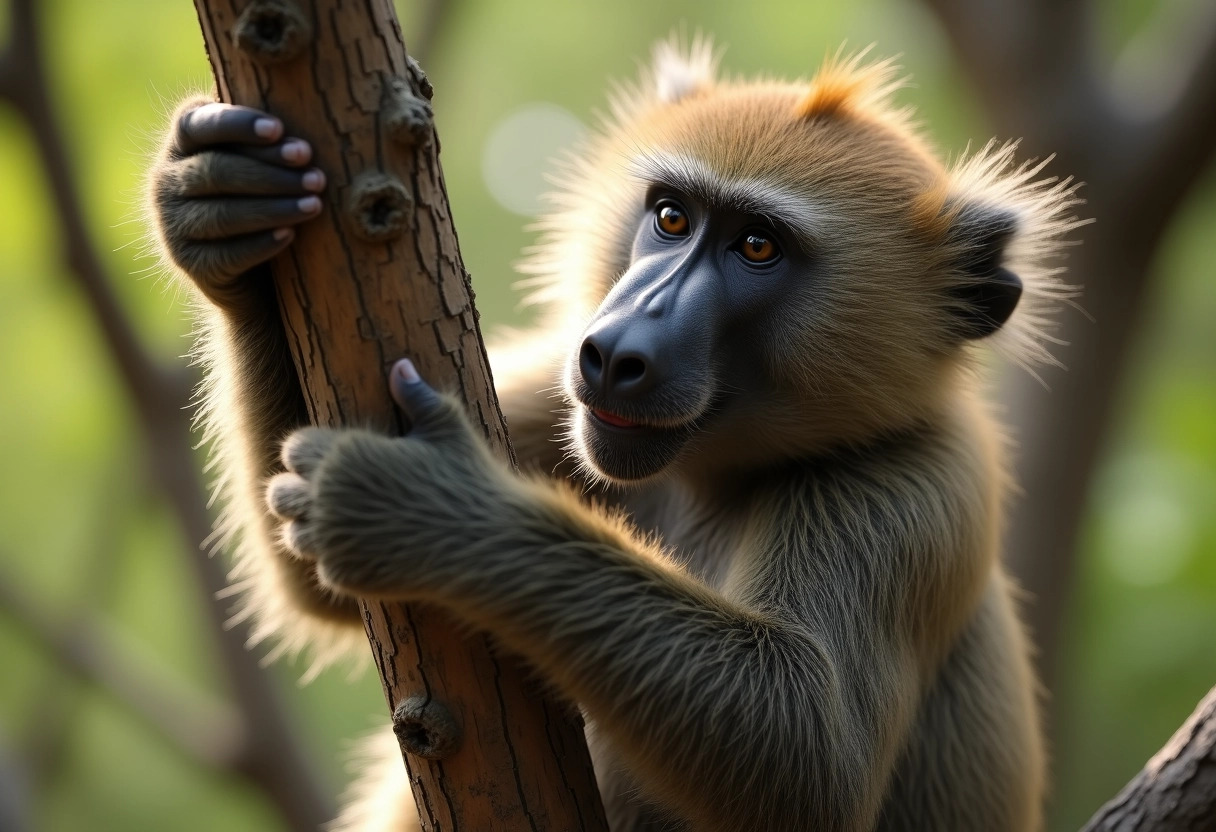
Unforeseen Functions of Baboon Anatomy
Baboons, beyond their unique appearance, possess anatomical attributes whose functions often exceed understanding. Their unique physiology offers a range of capabilities and adaptations that allow them to survive and thrive in varied environments.
One of the most intriguing characteristics concerns their ability to climb and move with remarkable ease. Thanks to their robust limbs and agility, baboons can navigate both trees and the ground. This duality grants them unparalleled flexibility in foraging for food and escaping from predators.
Baboons also stand out for their elaborate communication system. They use a combination of vocalizations, body postures, and physical contact to interact with one another. These modes of communication play a fundamental role in conflict management, group coordination, and the establishment of social hierarchies.
Their social behavior is equally fascinating. Baboons live in complex groups where each individual has a well-defined place. Relationships within these groups are governed by strict rules of dominance and submission. Group cohesion is maintained through grooming rituals and strategic alliances.
- Agility and mobility: adaptation to various environments
- Communication system: vocalizations, postures, physical contacts
- Social behavior: hierarchies and cohesion rituals
Research conducted by religious anthropologists and historians of the imagination, such as Régis Ladous and Paul Demont, highlights the importance of these functions in the evolution and survival of baboons. Philosophical debates surrounding Darwinism, initiated by Darwin, continue to enrich our understanding of these primates and their place in the animal world.