
The word “dimension” encompasses at least three distinct meanings depending on whether one is considering geometry, physics, or mathematical analysis. Confusing these three concepts hinders the understanding of scientific models and complicates learning from middle school onward. This article isolates each meaning to define it operationally and show where it concretely applies.
The French school curricula introduce the concept of dimension as early as middle school, first as a geometric property (2D, 3D), and then as a measurable physical quantity in mechanics. In the first year of university, dimensional analysis becomes a cross-cutting skill to check the consistency of equations. Understanding these three notions allows one to explore resources on E-novateur with a structured perspective and avoid frequent confusions between space, measurement, and modeling.
1. Spatial dimension in geometry: width, height, depth
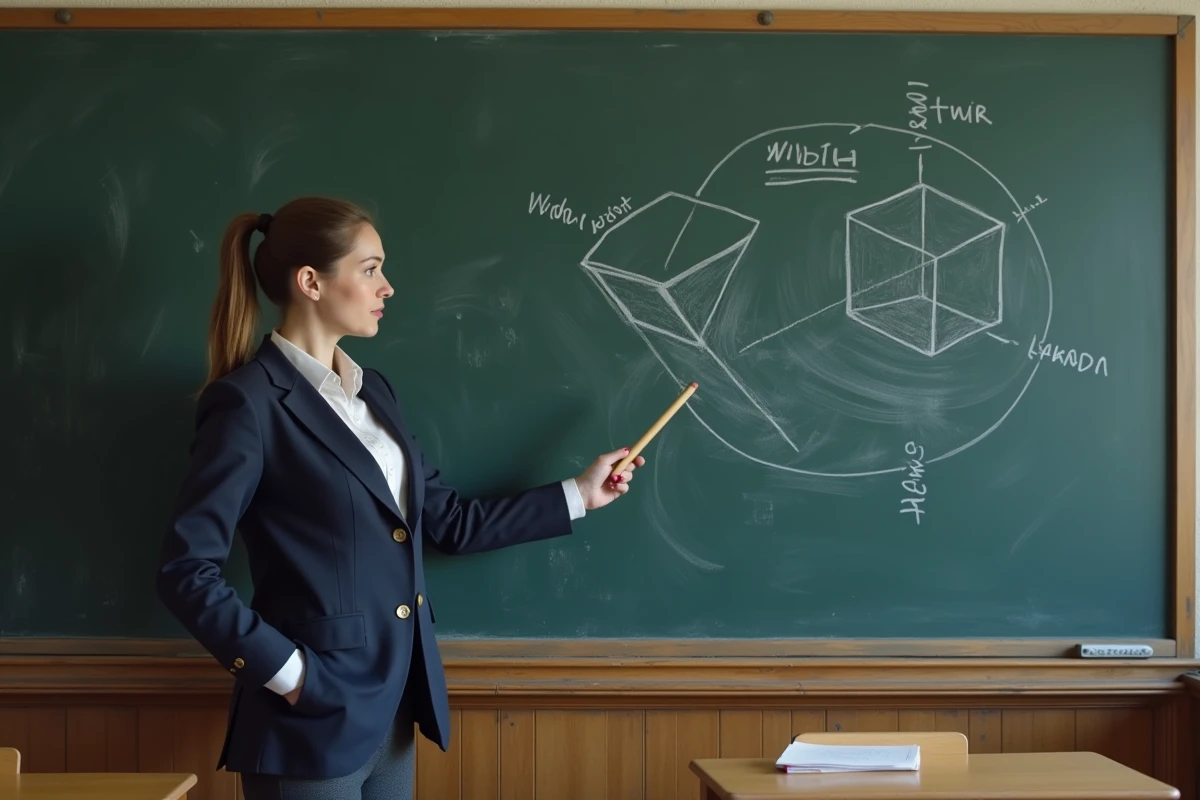
The spatial dimension refers to the number of independent directions needed to locate a point in space. A line segment has one dimension (length), a surface has two (width and height), and a volume has three (width, height, and depth). These three axes, often denoted as x, y, and z, are perpendicular to each other.
This perpendicularity is the central criterion. If two directions are not perpendicular, they do not constitute two distinct dimensions but rather a combination of the same one. In practice, manipulating an object in space involves moving, rotating, or resizing it along these three axes.
Learning this concept involves concrete manipulation. Suitable educational resources, especially for children with developmental disorders, focus on activities such as tiling, stacking volumes, and construction to anchor the understanding of space. The ability to think in 2D and then in 3D is developed as a specific cognitive skill, not merely as an abstract mathematical content.
Where spatial dimension applies in everyday life
3D modeling, architecture, video games, cartography: every digital representation of an object relies on a three-dimensional coordinate system. Computer-aided design software translates each point of an object into a triplet (x, y, z). Without this geometric foundation, no synthetic image or technical plan could exist.
2. The dimension of a physical quantity: mass, length, time

In physics, the word “dimension” does not refer to space but to the nature of a measurable quantity. A speed has the dimension of length divided by time. A force has the dimension of mass multiplied by length, divided by the square of time. These relationships are noted in brackets: [speed] = L·T⁻¹.
This convention allows one to verify that an equation is consistent even before solving it. If the left-hand side has the dimension of energy and the right-hand side has the dimension of force, the equation contains an error, regardless of the numerical result.
Dimensional analysis as a verification tool
In the early years of science university studies, dimensional analysis is taught as a cross-cutting skill. The mathematics syllabus at the University of Toulouse III incorporates this approach into mechanics and physical quantities courses. The explicit goal is to distinguish “mathematical dimension” (number of coordinates) from “dimension of a quantity” (physical nature of what is being measured).
This dual meaning of the word “dimension” is the most frequent source of confusion among students. A teacher who talks about “dimension” in geometry class and then in mechanics class uses the same term for two concepts that are not directly related. Identifying this distinction from the outset saves considerable time in the subsequent scientific journey.
- The spatial dimension answers the question “how many directions to locate a point?”
- The physical dimension answers the question “what is the nature of this quantity (length, mass, time)?”
- Confusing the two amounts to mixing a coordinate plane with a unit of measurement
3. Dimension as a tool for abstract modeling

Beyond geometry and physics, the notion of dimension extends to any space where independent variables describe a system. A dataset containing five characteristics (age, height, weight, income, score) defines a five-dimensional space. Each individual occupies a point identified by its five coordinates.
This extension is at the heart of machine learning and artificial intelligence. Classification or regression algorithms operate in spaces where the dimension can reach several hundred or even thousands of variables. The challenge lies not in visualization (impossible beyond three dimensions) but in the mathematical processing of these spaces.
The curse of dimensionality in big data
The more dimensions increase, the sparser the data becomes. This phenomenon, known as the curse of dimensionality, makes distances between points increasingly less meaningful. Two “close” points in a thousand-dimensional space do not necessarily share exploitable common characteristics.
Dimensionality reduction techniques aim to project data into a lower-dimensional space while preserving relevant information. This preprocessing step conditions the performance of predictive models in various fields such as image recognition, language processing, or financial analysis.
- In geometry, dimension describes the perceptible physical space
- In physics, it characterizes the nature of a measurable quantity
- In modeling, it quantifies the number of independent variables in a system
These three meanings share a common logic: counting the number of independent parameters necessary to completely describe an object, a quantity, or a system. The next time the word “dimension” appears in a class or technical article, identifying which of these three notions is at play helps avoid most misunderstandings.