The proliferation of educational advice available online, in magazines, and on social media places parents in a paradox: the more abundant the information, the greater the feeling of not doing enough. The 2024 UNAF barometer on mental load and parenting reveals a significant increase in emotional fatigue related to “doing well with children” on a daily basis.
Supporting a child in their activities, education, or learning is not just about piling up recipes. It involves sorting, letting go of certain injunctions, and choosing what works in a specific family context.
Related reading : Understanding the prison canteen: operation, budget, and tips for effective management
Parental mental load and educational pressure: what the field says
The concept of parental mental load goes far beyond the logistical management of the household. It now encompasses constant vigilance over educational practices, comparison with other families via social media, and the feeling of being continuously evaluated. UNAF notes that this pressure primarily affects mothers, but fathers in full-time employment also report increasing fatigue in this regard.
In practical terms, trying to simultaneously apply positive parenting, zero screen time, homemade cooking, and active school monitoring creates a saturation effect. The daily connection with the child sometimes suffers more than if the parent had simply chosen two priorities and let go of the rest. Exploring children’s resources on Une Famille allows for targeting suitable options for each age group rather than scattering efforts.
You may also like : Ideas and Inspirations for a Warm and Personalized Interior Decoration
The first step is to identify what generates tension in your daily organization and then accept that not everything can be optimized at the same time.

Screens and children: co-viewing rather than prohibition
French recommendations on screens have evolved in recent years. The HCSP and Public Health France now emphasize less on strict prohibition and more on adult-child co-presence in front of the screen. Co-viewing, meaning watching content with the child and discussing it, changes the nature of exposure.
The idea is not to validate two hours of passive cartoons. It is about distinguishing interactive, ad-free, age-appropriate content from passive video streams. A child who watches a short program and then draws what they saw or reenacts a scene gains benefits that simple passive consumption does not provide.
Criteria for choosing suitable content
- The program is designed for the child’s age group, with a slow pace and clear narrative sequences for those under six.
- It contains no embedded advertising or mechanisms like “next episode automatically” that extend the session without conscious decision.
- It lends itself to an off-screen extension activity: coloring, discussion, manipulation of objects related to the topic addressed.
This approach does not solve everything. Field feedback varies on realistic screen time depending on age and family context (large siblings, single parent, remote work). The rigidity of a single rule (“zero screen time before three years”) can create more guilt than benefit if it does not match the household’s reality.
Everyday learning: turning routines into concrete opportunities
Online competitors often offer lists of educational activities (cooking, laundry, cleaning). The key angle to consider is not the list itself, but how a household task engages specific skills in the child, and the limits of this approach.
Asking a child to weigh ingredients engages counting and fine motor skills. Having them write a shopping list works on reading and writing. Informal learning works when the adult makes explicit what is happening: naming quantities, asking a question about the order of steps, reformulating together what has just been done.
Homework and school motivation: the role of the environment
Homework support remains a source of tension in many households. Some teachers have reduced or eliminated homework, while others maintain a daily practice. The parent finds themselves in a middle ground.
What emerges from documented practices can be summarized in a few key points:
- A fixed workspace (kitchen table, desk) with proper lighting and minimal visual distractions.
- A regular time slot, not necessarily long, that creates a temporal reference rather than daily negotiation.
- A role as a supporter rather than a corrector: asking open-ended questions (“How would you check your answer?”) rather than directly pointing out the mistake.
- The possibility of calling on a third party (tutoring, online academic support) when the parent-child relationship becomes tense around homework.

Awakening activities and free play: the trap of overstimulation
Filling a child’s schedule with extracurricular activities, creative workshops, and educational outings may seem beneficial. The available data do not allow for a universal threshold for overstimulation, but several early childhood professionals warn that unstructured free play remains an underestimated development lever.
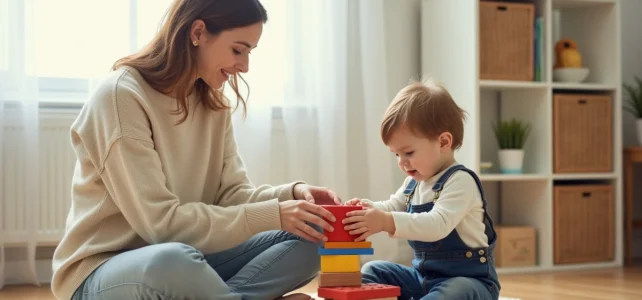
Free play is a child who is bored for five minutes, grabs three cushions, and invents a scenario. No educational objective, no adult instructions. This form of activity develops initiative, frustration management, and creativity, skills that are difficult to cultivate in a structured setting.
The challenge for the parent is not to ban organized activities but to ensure that there are still empty time slots in the week, without a program. A child who does not know what to do for twenty minutes is not failing. They are mobilizing their own resources.
Supporting a child daily ultimately means constantly balancing what one would like to do and what the context allows. The UNAF barometer confirms this: the quality of the parent-child bond withstands better when the parent accepts their own limits than when they try to check all the boxes of an idealized educational model.