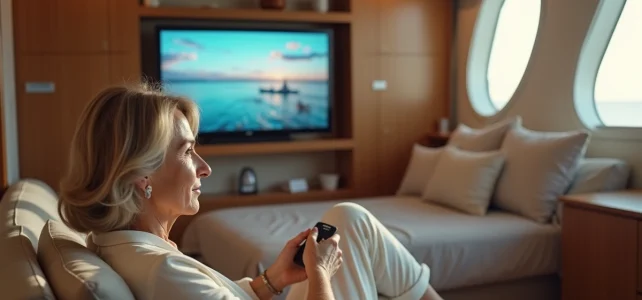
Cruise cabins all come equipped with a television, but the accessible content varies greatly from one company to another. The distinction between free channels and paid options depends on the satellite broadcasting agreements that each operator negotiates with audiovisual groups, as well as the type of digital portal installed on board.
Satellite reception at sea: how television reaches your cabin
A cruise ship does not receive terrestrial television. Broadcasting relies on stabilized satellite antennas mounted on the upper deck, which track geostationary satellites despite the ship’s movements.
Read also : Bayton or Birkenstock: the complete comparison to choose your next sandals
This system allows for the reception of international packages, but coverage depends on the navigation area. In the Mediterranean or along European coasts, reception remains stable. In the middle of the Atlantic or in the Pacific, some channels disappear due to lack of satellite coverage.
The ability to watch television while cruising therefore depends as much on the chosen itinerary as on the package subscribed. A Nordic cruise does not offer the same range as a Caribbean crossing, even on the same ship.
See also : Workshop France Work mandatory or not: what you really need to know
Companies supplement satellite reception with an internal network (IPTV) that distributes on-board content: information about ports of call, activity schedules, real-time exterior cameras. This network operates without satellite and remains available regardless of the ship’s position.
Free channels in the cabin: what is actually included in the price
Since 2023-2024, the trend among major companies is to expand the free offerings. MSC and Norwegian Cruise Line broadcast at least one international news channel and one multilingual children’s channel in all cabins, including in their entry-level ranges.
Royal Caribbean and Carnival have adopted a similar approach by deploying internal streaming portals. These portals group several types of content accessible at no extra charge:
- Children’s and family programs, often sourced from catalogs negotiated with major studios
- On-board information (weather, itinerary, port schedules) broadcast on a dedicated channel
- A selection of recent movies, updated according to current licensing agreements
This evolution responds to a demand that emerged after the Covid period: passengers want continuous access to information and family entertainment without having to pull out their credit card as soon as they board.
However, the free content remains limited in volume. On most ships, the selection of movies revolves around a few dozen titles. French terrestrial channels (France 2, TF1) are almost never available in clear due to lack of broadcasting rights outside the territory.
Paid offers on board: sports, cinema, and premium streaming
International sports and cinema channels make up the bulk of the paid options. Their billing takes two forms depending on the companies: a daily package or a cruise package covering the entire stay.
Premium TV packages and sports bundles
Sports and cinema channels are charged extra on almost all fleets. The price depends on the company and the duration of the cruise, but the principle is constant: high-value licensed content costs the operator more, and this additional cost is passed on.
Some companies bundle premium TV access with high-speed internet packages. In this case, a single subscription grants access to paid channels on the cabin television and streaming on personal devices.
Personal streaming via the ship’s Wi-Fi
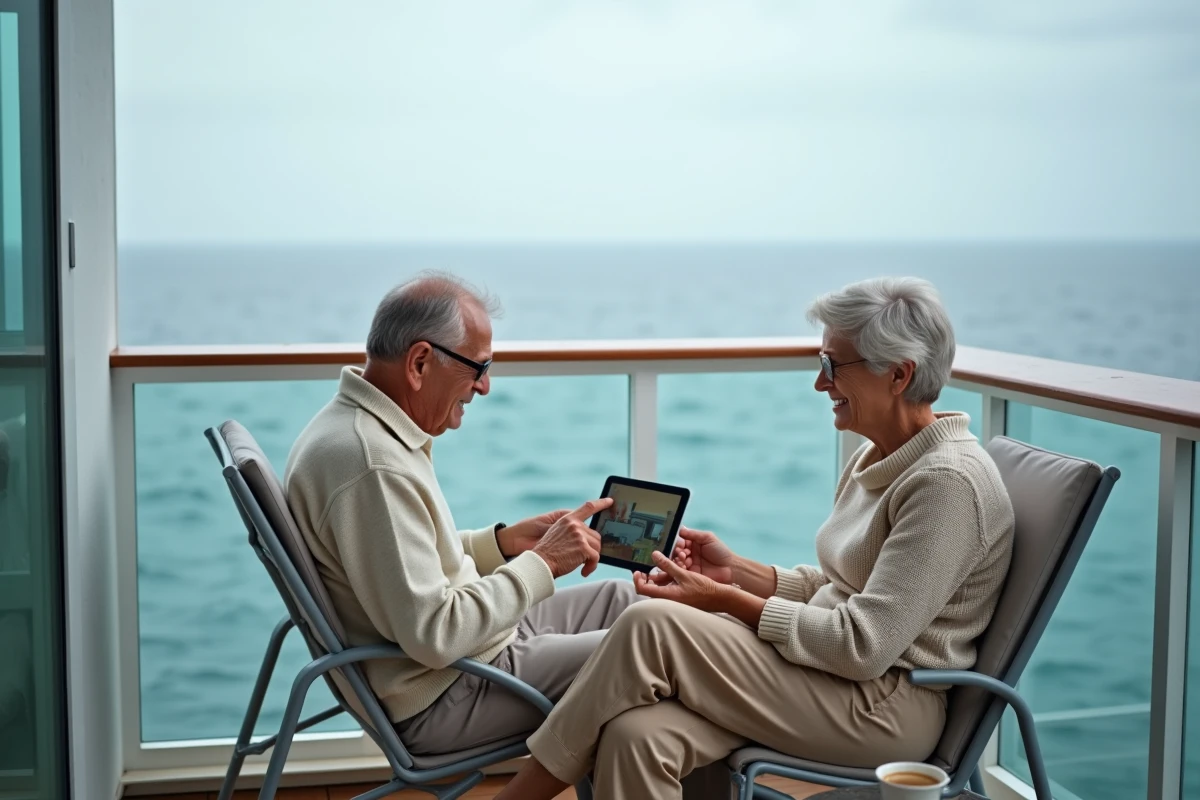
Watching Netflix, Disney+, or Amazon Prime Video from your tablet on board is technically possible, but only with a sufficiently fast internet package. The basic Wi-Fi offered for free or at a low price does not support video streaming.
High-speed internet packages, designed for HD streaming and video calls, represent a significant additional budget on a long cruise. Before relying on your own streaming subscriptions, check that the bandwidth of the chosen package actually allows it.
Cross-device broadcasting rights: a recent evolution to watch
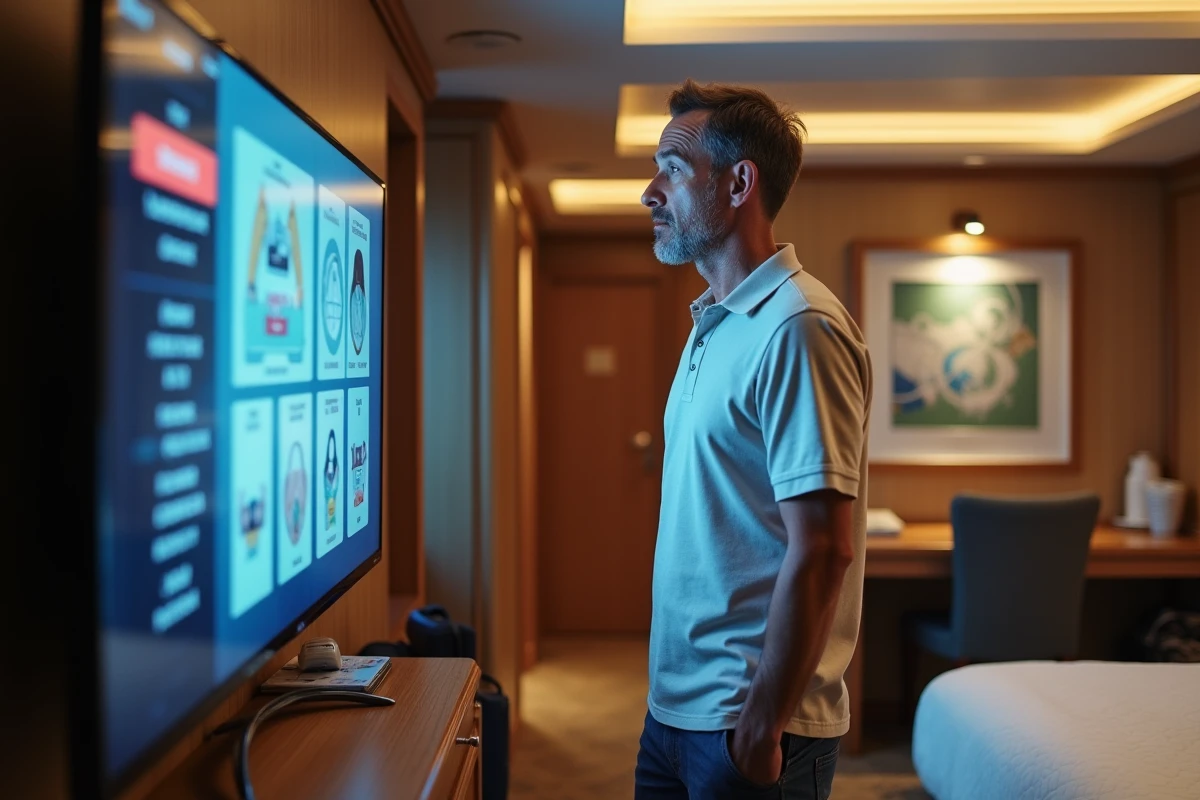
Since 2022-2023, contracts between operators and major audiovisual groups (Disney, Warner Bros. Discovery, NBCUniversal) increasingly include so-called “cross-device” rights. In practical terms, some content becomes accessible on the cabin television and on passengers’ personal devices connected to the ship’s network.
Disney Cruise Line is the most advanced company in this area, with expanded access to the Disney+ catalog integrated into the on-board portal on certain routes. Royal Caribbean offers a comparable system on part of its fleet.
This cross-device approach changes the game for families: a child can watch a movie on the tablet while parents follow another channel on the television, all through a single package. The model is still being gradually rolled out and is not yet generalized across all fleets.
Free or paid: criteria for making the right choice on a cruise
The choice between free channels and paid options depends on three concrete factors:
- The duration of the cruise: on a few days crossing, free content is more than sufficient between ports of call and on-board activities
- The composition of the group: families with children get more out of free portals (including youth content) than sports enthusiasts who will need to subscribe to a package
- The itinerary: an ocean cruise with several consecutive days at sea makes the paid offer more relevant than a coastal cabotage where time in the cabin is limited
Free content meets the needs of the majority of passengers. Premium packages are mainly justified for following a specific sporting event or for using personal streaming services with sufficient bandwidth. Checking your company’s exact offerings before boarding remains the best way to avoid unnecessary expenses on board.