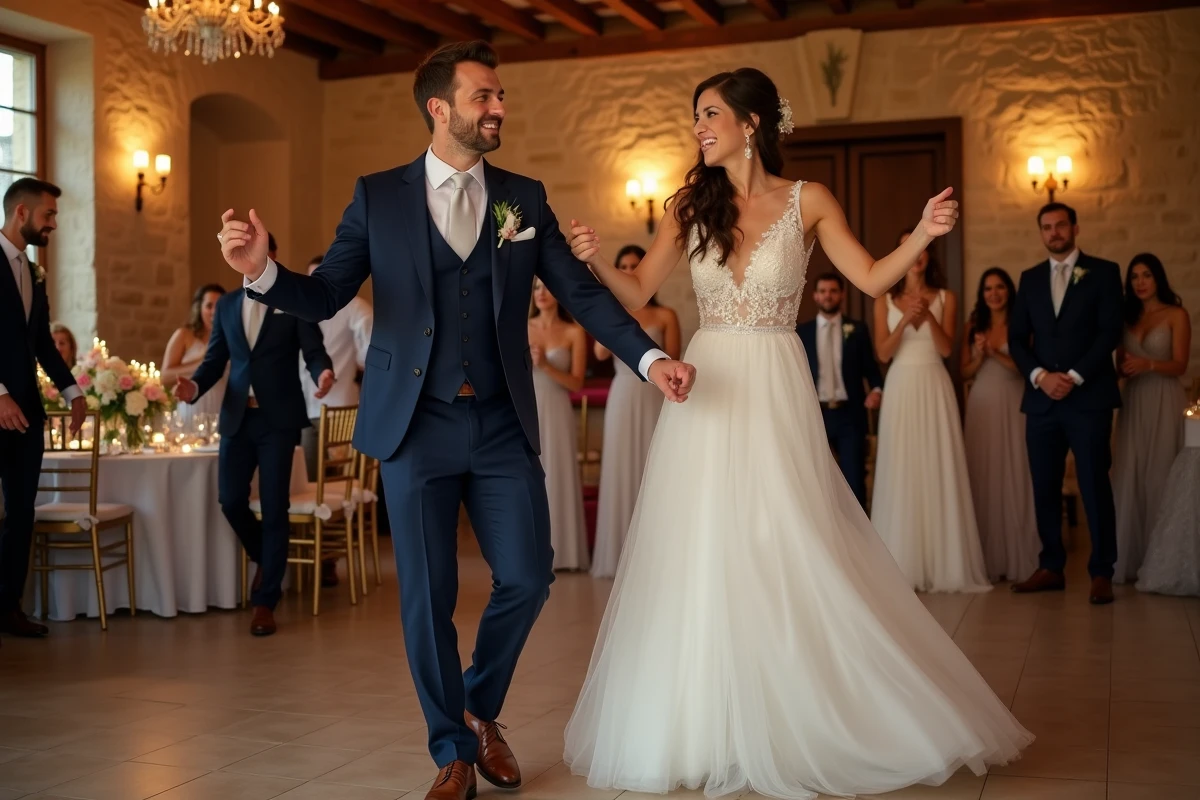
The Madison is a codified line dance, performed without a partner, to a steady rhythm close to slow rock. At a wedding, this collective choreography serves a specific purpose: to get guests who do not know each other to stand up simultaneously, without putting them in a technical bind. The challenge is to choose songs that maintain this unifying potential while fitting into a refined atmosphere.
Dance Floor Energy and BPM: The Criteria Generic Playlists Ignore
Most wedding music selections categorize songs by genre or by moment of the evening. For the Madison, this division does not work. What matters is the tempo and dance floor energy, not the stylistic label.
A classic Madison revolves around a moderate tempo, slow enough for beginners to follow the steps, yet engaging enough not to bore regular dancers. Songs that are too fast turn the dance into a race, while those that are too slow make it sluggish.
To create a modern Madison music playlist for weddings, it’s better to sort tracks by energy level rather than by decade or artist. A recent pop song with the right tempo will work better than a classic from the 60s played too quickly.
Madison and Wedding Elegance: Placement, Duration, and Transitions

The Madison suffers from a reputation as a “camping” or “fair” dance. This perception rarely comes from the dance itself but from its placement at the wrong time. Launched too early, it breaks the cocktail atmosphere. Launched too late, when the dance floor is already in full club mode, it creates a jarring rhythm break.
The Optimal Slot in the Evening
The Madison works as a dance floor trigger, not as an energy peak. Its logical place is just after the first dance and the initial slow dances, at a moment when guests are still hesitant to get up. The line choreography removes the barrier of “I have no one to dance with.”
Two to three Madison songs are enough to fulfill this role. Beyond that, the effect wanes, and the dance floor risks emptying. Following up with a more free disco or funk track keeps people standing while changing the vibe.
Musical Transitions to Avoid Breaks
The transition to the Madison must be prepared. An experienced DJ gradually lowers the tempo of the previous song or uses a crossfade to the first Madison track. The return to the main playlist follows the same logic: a mid-tempo transition song avoids the shock between line dance and free dance.
Without a DJ, this transition is trickier. It’s necessary to include an intermediate track in the playlist, neither Madison nor dance floor hit, that serves as an audio bridge.
Selection of Modern Madison Tracks for Weddings
The classics of Madison (the original “Madison Time,” certain rock’n’roll tracks from the 60s) remain effective with an audience familiar with the steps. For a wedding where most guests are discovering the dance, more recent tracks with a clear rhythmic structure work better.
Here are the selection criteria that matter for a wedding:
- A steady tempo without sudden variations, so the steps remain synchronized from the beginning to the end of the track
- A recognizable melody from the first few seconds, encouraging people to join the dance floor even without knowing the song
- A contained duration (three to four minutes maximum), because a Madison that is too long tires non-dancers and creates an energy plateau
- A cleanly produced sound, without distortion or excessive bass, to remain audible in a reception hall with reverb
Mixing a classic recognized by older guests with two recent pop or electro tracks at the appropriate tempo creates a sequence that appeals to all age groups.
The Madison as an Intergenerational Tool: For Which Guest Profiles
A wedding often brings together three generations on the same dance floor. The Madison solves a concrete problem: guests over 60 and teenagers rarely share the same dance reflexes. The line choreography imposes a common framework that neutralizes this difference.
Grandparents find a reassuring structure (codified steps, no imposed physical contact). Younger guests see it as a collective challenge, especially if the chosen song belongs to their musical universe. International or non-French-speaking guests, common at modern weddings, can follow the movements by imitation without understanding the lyrics.
When the Madison is Not the Right Choice
In certain configurations, the Madison risks falling flat. If most guests come from a different dance culture (salsa, belly dance, African dances), imposing a North American line dance can seem artificial. In this case, a collective dance from the group’s dominant cultural repertoire will be more unifying.
Similarly, for a very intimate wedding (fewer than thirty guests), the mass effect necessary for the Madison will not be present. Line dancing draws its strength from numbers.
Building Your Madison Playlist: Order and Dosage of Tracks
A common mistake is to group all Madison tracks into a compact block. This approach creates an identified “Madison moment,” which resembles a programmed number rather than a spontaneous time of the party.
A more fluid alternative:
- Place the first Madison just after the opening dance to launch the floor
- Slip in a second Madison later in the evening, between two sequences of hits, as a reminder that reignites collective energy
- Keep a third track in reserve, to be triggered only if the floor empties, as a tool for revival rather than a mandatory passage
Distributing Madison tracks throughout the evening instead of concentrating them helps maintain their surprise effect and avoid fatigue. The Madison then remains a moment of collective complicity, not an imposed exercise.
The choice of the last song of the evening also deserves reflection. Ending with a collective Madison, if the energy of the room allows it, leaves an image of a united group. Ending with a slow song after a Madison creates a strong emotional contrast that marks the memory of the guests.