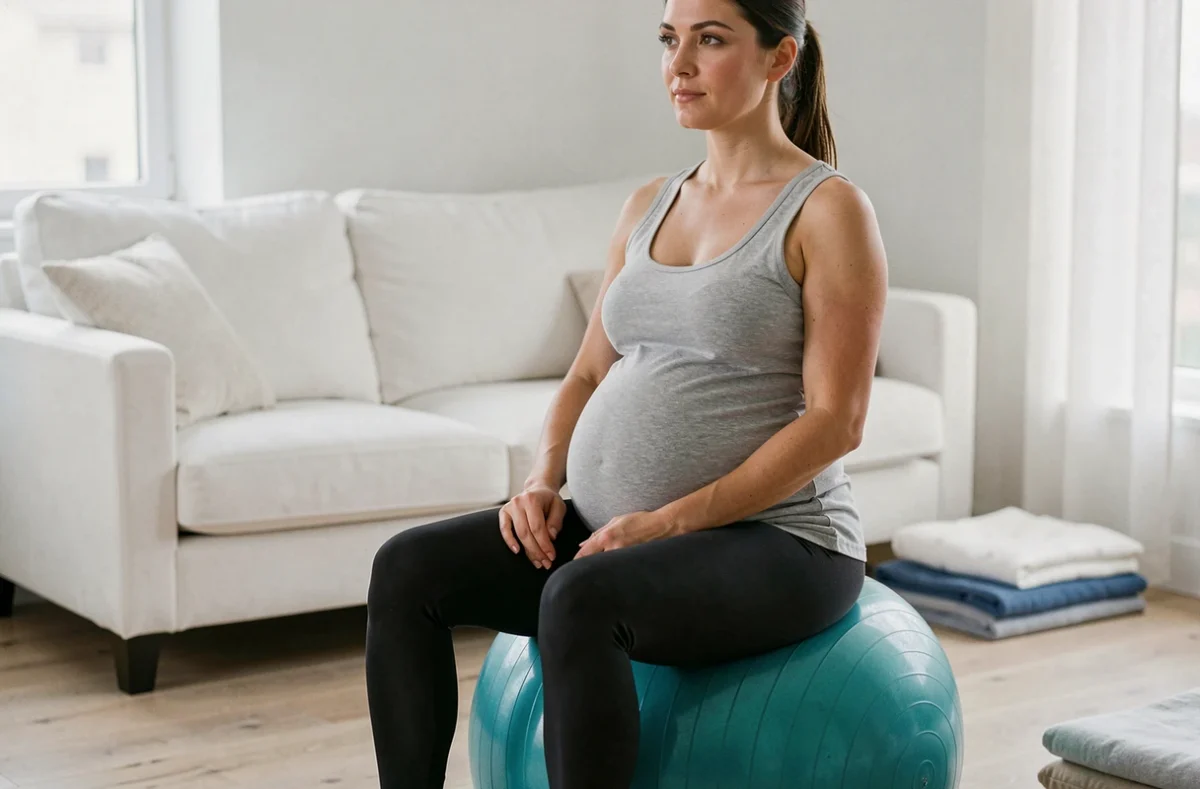
Pregnancy ball size guides give broad, sometimes conflicting ranges. One manufacturer recommends a 65 cm ball for anyone from 1.50 m tall, while a midwives’ guide suggests a 55 cm ball for anyone under 1.63 m. At 1.57 m, the answer isn’t obvious, and the right choice depends on factors that a size chart alone can’t resolve.
Leg length and inflation: what size charts don’t measure
Size-to-diameter recommendations published by brands are based on average body proportions. Two women who are both 1.57 m tall may have leg lengths that differ by several centimetres, affecting their actual seated height on the ball.
Inflation level plays a similar role. A fully inflated 65 cm ball provides a higher seat than the same ball when slightly deflated. A person’s weight also compresses the PVC: the heavier the load, the more the ball sinks. Together, these two variables explain why the same model may or may not be suitable depending on how it is set up.
So, choosing the right birth ball size for someone who is 1.57 m tall is less about consulting a chart and more about trying it out in real conditions, sitting with both feet flat on the floor.
The 90-degree angle test: the only reliable way to check a birth ball
Healthcare professionals use a simple posture to assess the fit. When seated on an inflated ball with both feet flat on the floor, your hips should be level with your knees or slightly higher. The angle between your thigh and shin should be close to 90 degrees.
If your knees are higher than your hips, the ball is too low: your pelvis tilts backwards, reducing the benefits of the position. If your feet don’t reach the floor unless you’re on tiptoe, the ball is too high and compromises your stability.
How to do this test at home
- Inflate the ball on a flat, non-slip surface, keeping the pump nearby so you can adjust the pressure.
- Sit in the centre of the ball with your feet hip-width apart and your back straight, without leaning against a wall.
- Check that your feet are flat on the floor and your thighs are horizontal or slope slightly down towards your knees.
- Ask someone to check from the side whether the angle between your thigh and shin is close to 90 degrees, or use a mirror.
Ideally, do this test towards the end of the second trimester, when your growing bump starts to affect your seated position. The Trideer guide recommends having someone nearby in case you feel unsteady during the test.
55 cm or 65 cm birth ball at 1.57 m: two practical scenarios
Most articles recommend a 65 cm ball as the default for someone who is 1.57 m tall. Depending on the manufacturer, this size is suitable for people from around 1.55 m to 1.75 m, making it the most widely available option in shops and maternity units.
A 55 cm ball is worth considering in two specific cases. First, if your legs are proportionally short compared with your torso—a common situation that is rarely measured. Second, if you prefer a firm, fully inflated ball that won’t sink under your weight and will therefore keep you seated higher.
A slightly deflated 65 cm ball can provide the same seat height as a well-inflated 55 cm ball. This flexibility is why the 65 cm remains the most versatile choice at this height: you can adjust the seat height by changing the air pressure, whereas a fully inflated 55 cm ball can’t be made any taller.
How ball diameter affects labour
During contractions, your position on the ball changes. Pelvic tilts, circles and gentle bouncing all require a ball that lets you keep your feet firmly on the floor. A ball that’s too large forces you to spread your legs further to stay balanced, which can tire your inner thigh muscles.
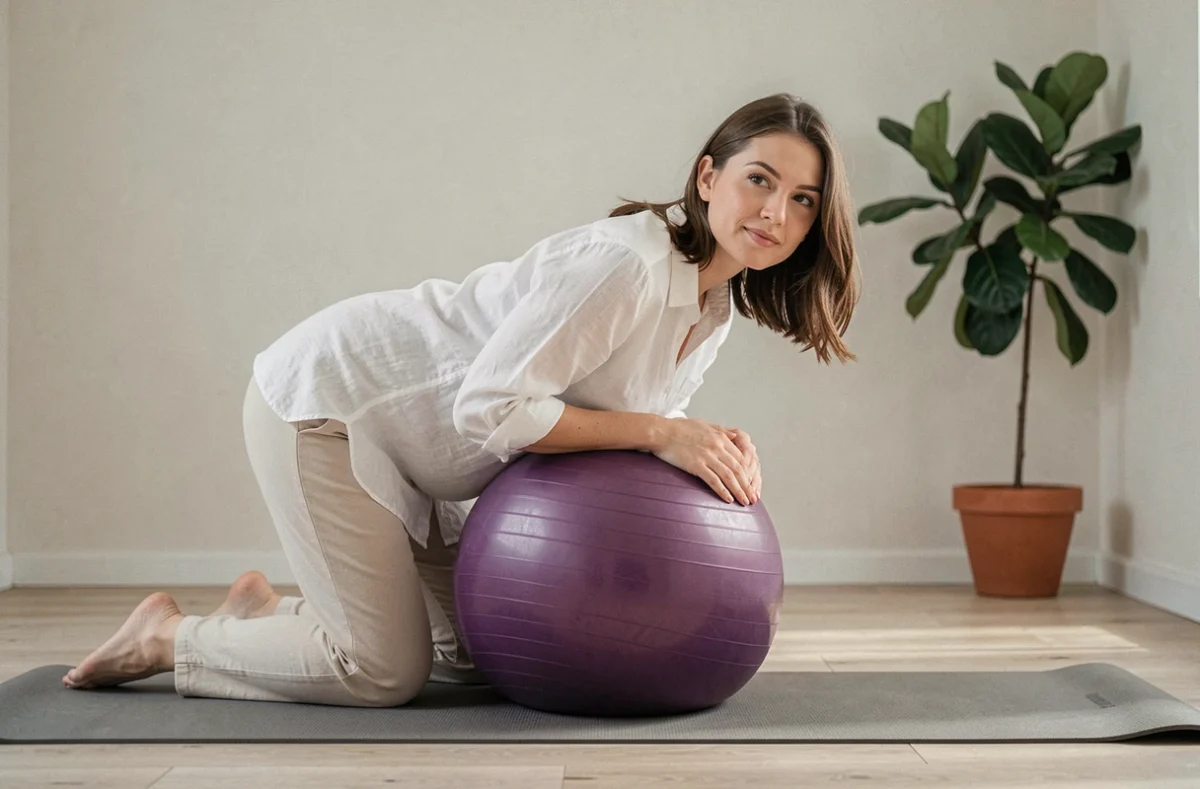
A well-fitted ball lets you try different positions: sitting upright, leaning forward with your arms resting on the bed, or even kneeling against the ball. Keeping your feet stable on the floor gives your pelvis more freedom to move.
Round ball or peanut ball: which shape is best for the birth room?
The classic round ball is still the most commonly used for active movement: rocking, pelvic circles and upright positions. It requires you to maintain your own balance, making it more physically demanding.
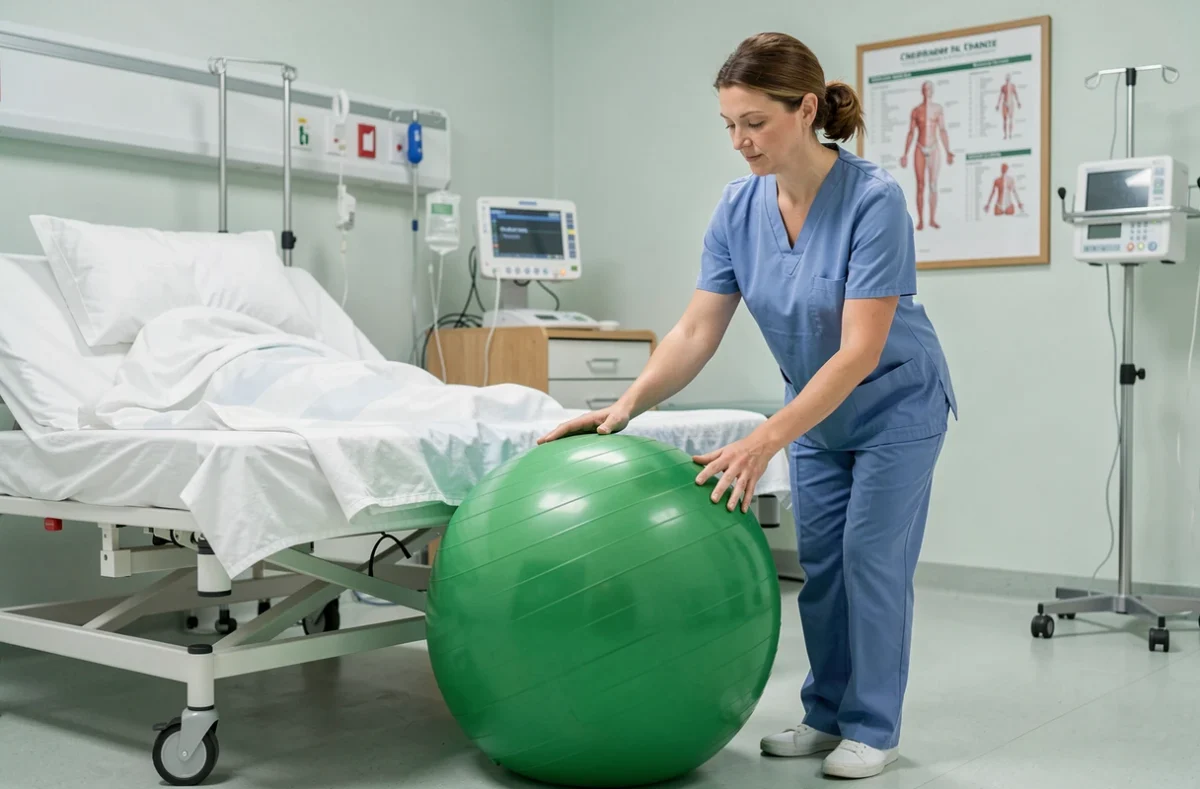
A peanut ball has a different shape and profile. Its elongated form prevents it from rolling sideways, making it suitable for lying or semi-reclined positions, including when you have an epidural. A peanut ball is placed between your legs to keep your pelvis open without requiring active muscle effort.
For someone who is 1.57 m tall, the choice of shape depends on your birth plan. A 55 or 65 cm round ball is suitable for preparing at home and for the early stages of active labour. A peanut ball is used more often in the birth room, where it is often provided by the maternity unit. It is sized differently: based on how far apart you want your legs, not your standing height.
What to check before buying: material, weight limit and anti-burst design
Beyond the diameter, check these three technical features before ordering a pregnancy ball:
- Anti-burst system: if punctured, the ball deflates slowly rather than bursting. This is essential for use in late pregnancy.
- Maximum weight capacity: make sure the manufacturer’s stated limit is well above your expected weight at the end of pregnancy, to accommodate dynamic movements such as bouncing and shifting your weight.
- Textured or smooth surface: a lightly ridged surface improves grip if you start to sweat, which is common during labour.
Most balls are made from soft PVC. Some brands offer phthalate-free balls, which may be worth considering if you plan to use one throughout your pregnancy.
The right ball for someone who is 1.57 m tall isn’t the one a chart recommends; it’s the one that lets their feet reach the floor while keeping their pelvis free to move. A few minutes of testing on a flat surface with the ball inflated will give you a clearer answer than any size guide.